
Centering Equity and Mentorship: Dr. GG’s Journey Through HIV Research and Doctoral Succes
April 14, 2026
Dr. GG, a PhD student at WashU, recently defended their dissertation, marking an enormous milestone in their academic and professional career. Dr. GG is a longtime research collaborator of Ginger McKay, PhD, MA, Dissemination and Implementation Science Core Director, and Kneeshe Parkinson, Scientific Working Group Coordinator. Dr. McKay has mentored Dr. GG throughout their PhD program, providing research (and emotional) support, and sitting on Dr. GG’s dissertation committee.
We sat down with Dr. GG and Dr. McKay to learn what this accomplishment means for them, and how mentorship has factored into GG’s growth as a scholar and professional. Congratulations, Dr. GG, on successfully defending!
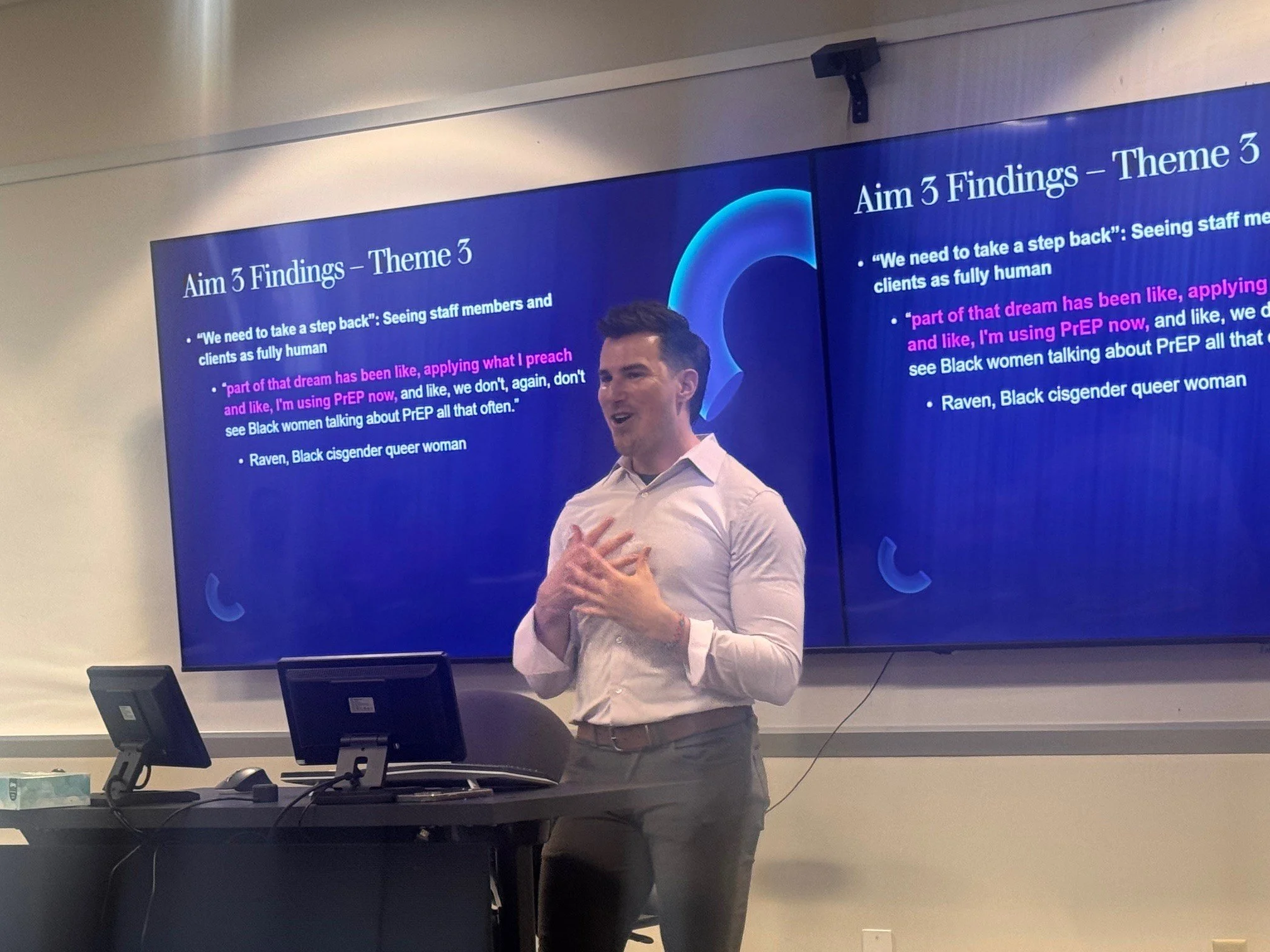
GG defending their dissertaton.
Dr. GG: I’m Gregory Gross, but please call me GG or Dr. GG (they/them). I’m from Iowa and I worked in HIV service organizations for about 10 years after doing my master’s in social work. Ever since my undergraduate interests in social psychology research, I’d thought about returning to school for my PhD. I’m passionate about teaching and I always found myself being drawn to big picture questions about understanding and responding to inequity and injustice in HIV work. As a PhD student at WashU, I had the opportunity to get involved with multiple HIV-related research projects. My research interests apply a critical health equity and intersectional lens to examining the racialization of HIV service delivery systems to understand and disrupt pathways by which inequity is perpetuated for workers, clients, and communities impacted by HIV.
Dr. GG, as you prepared for your dissertation defense, what strategies or practices helped you feel confident going into that moment?
Dr. GG: My goal was to feel confident and grounded during my defense. As a person who’s experienced multiple forms of trauma and struggles with anxiety, I wanted to find a way that I could be present in my body during this important step in my academic journey. To accomplish that, I tackled my tendency to procrastinate head-on. I plotted out a schedule to complete a draft of my slides and scheduled multiple practice sessions. I used the Speaking Lab through the WashU Writing Center for a couple of these sessions. For other practice, I sought out trusted colleagues who I knew would take the time to listen and offer thoughtful feedback to help me improve. The second part that helped me feel grounded was the support of loved ones. My friends and family (biological and chosen) were invited to my defense. Knowing that some of them would be there in person and on Zoom lifted my spirits. Multiple people reached out with messages leading up to the defense which made me feel loved and supported. Members of the Clear Path Collaborative, which brings together HIV testing providers in STL, has been an amazing source of support and friendship.
Reflecting on the mentors and supporters you acknowledged, how did their guidance shape your growth as a scholar and professional?
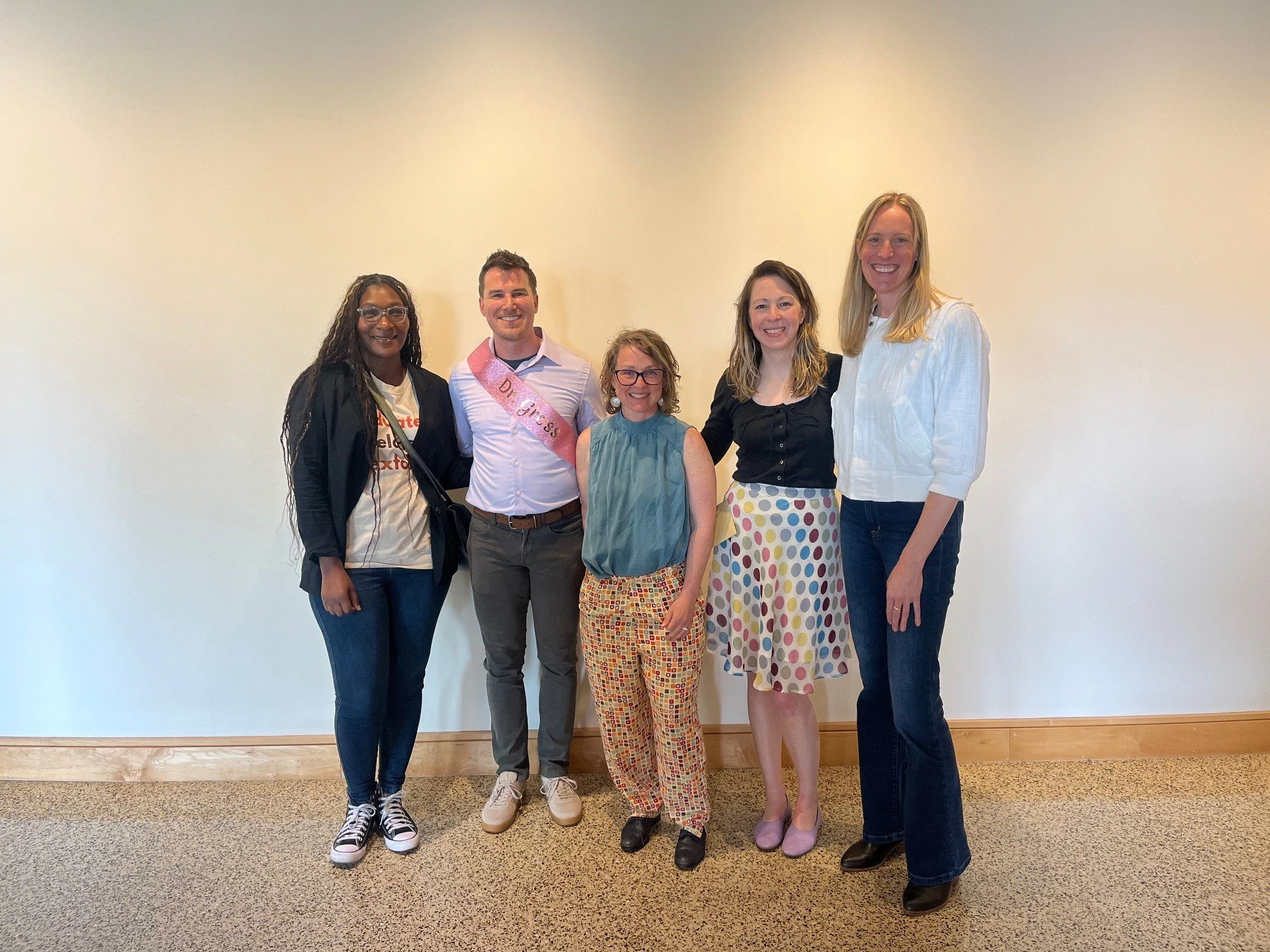
Four of Dr. GG’s committee members (L-R): Dr. Sheretta Butler-Barnes, GG, Dr. Ginger McKay, Dr. Theresa Anasti, Dr. Vanessa Fabbre
Dr. GG: Mentorship was a major reason I could be successful. I sought out mentors who I knew wholeheartedly believed in my capabilities. I knew that if I could trust that they believed in me, then I could interpret their feedback and constructive criticism as opportunities to do better. One of my closest faculty mentors is a queer cisgender white woman. Having a mentor who was queer helped me to feel connected and trust that she understood where I was coming from. Also, as both of us are relatively privileged (e.g., white, middle-class, able-bodied, not living with HIV), we had frequent conversations about privilege, oppression, and the capacity to do harm. Our continued dialogue about critical reflexivity, the examination of power in all aspects of the research (and life), were instrumental in helping me develop skills around critical reflexivity that benefit me as a professional and a person. Another close faculty member is a Black cisgender woman who helped me live up to my values as a person, professional, and researcher. She helped me to integrate a consideration of “who’s being excluded?” into my approach to the research process and doing work with oppressed communities. Her Anti-Racism Lecture Series through the Brown School brought in speakers from across the U.S. who instilled valuable perspectives about doing research and social work in anti-racist, anti-oppressive ways. During one of our phone conversations when I was struggling with where to go with my dissertation research, she encouraged me to consider the question “what keeps you up at night?". That question has been a north star for me to guide me to the work that meaningfully and authentically aligns with my ideology and values.
Ginger, what was your role in supporting Dr. GG throughout this journey, and how did you see their development evolve over time?
Dr. McKay: I was responsible for overseeing GG’s dissertation, and I began working with GG at the point at which they were considering the direction of their dissertation. We had been working together on another project prior to that. At the point where you’re trying to settle on a topic for your dissertations, it is often a difficult time because it is hard to come up with a research idea that is both feasible to complete and meaningful. It can feel overwhelming and intimidating, and that’s what I think GG was experiencing. My role as I viewed it was to act as a sounding board, provide the kind of feedback that they might typically get from another scientist, provide encouragement with difficult decisions or experiences, and help problem solve. In short, my role was to help them be successful in the process of developing, carrying out, and then defending the science for their dissertation research.
Throughout this process, I have watched GG evolve from someone who was unsure about most decisions to someone who is very comfortable and capable. On top of that, I feel like they are on a path where they have established a foundation of resiliency in their professional life that will be needed as they move through the world as a scientist.
Why is mentorship such a critical component in helping PhD students grow, adapt, and evolve throughout their academic journey?
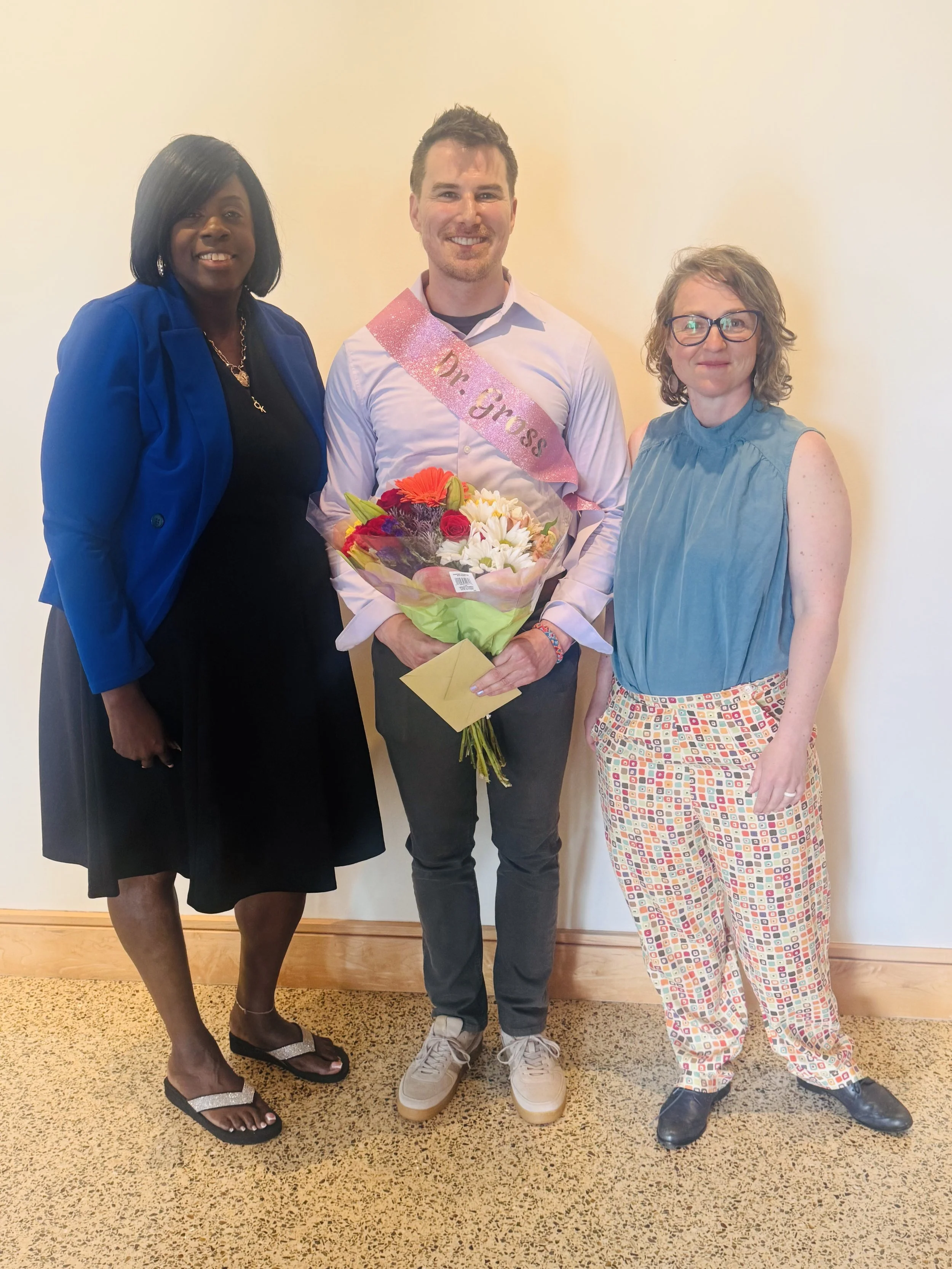
Kneeshe Parkinson (left), GG (center), and Ginger McKay (right) pose for a picture following GG’s successful defense.
Dr. GG: Mentorship is essential to be successful in a PhD program. Especially for students who hold and navigate life with oppressed identities, the core beliefs of feeling like we don’t belong and aren’t worthy can be so deeply rooted. In an academic system that is often critical, in toxic ways at times, those beliefs are consistently brought to the fore. Mentorship acts as a mirror, reflecting back to you that you are worthy, you’re good enough, and that you have what it takes to succeed. Mentors also act as role models to offer reassurance, advice, support, and open sharing about their struggles. Their insights about what worked for them, what doubts they had or still carry with them, and their stories about navigating oppressive academic systems remind students that they’re not alone in pushing back on injustice and ultimately help them to persevere.
Finally, could each of you share one quote that captures your experience or philosophy on this journey?
Dr. GG: Avoidance has been one of my greatest struggles because I worry that what I do will never be good enough. Ginger said to me many times over the past couple of years: “just keep going”. And I can honestly say that it’s always been enough when I just kept going.
Dr. McKay: Getting a PhD is about becoming a scientist regardless of the topic you study. I routinely said, “You have to have a reason”, meaning to you have to have a scientific reason that guides the next steps in your research and by extension improves the quality of the work. GG embraced this idea, and I can truly say that they are a scientist now.
Interview conducted by Kneeshe Parkinson, edited by Kate Gershwin.