
Co-Designing Change: A Conversation with ChampionSTL on Community Power and Health Equity
April 15, 2026
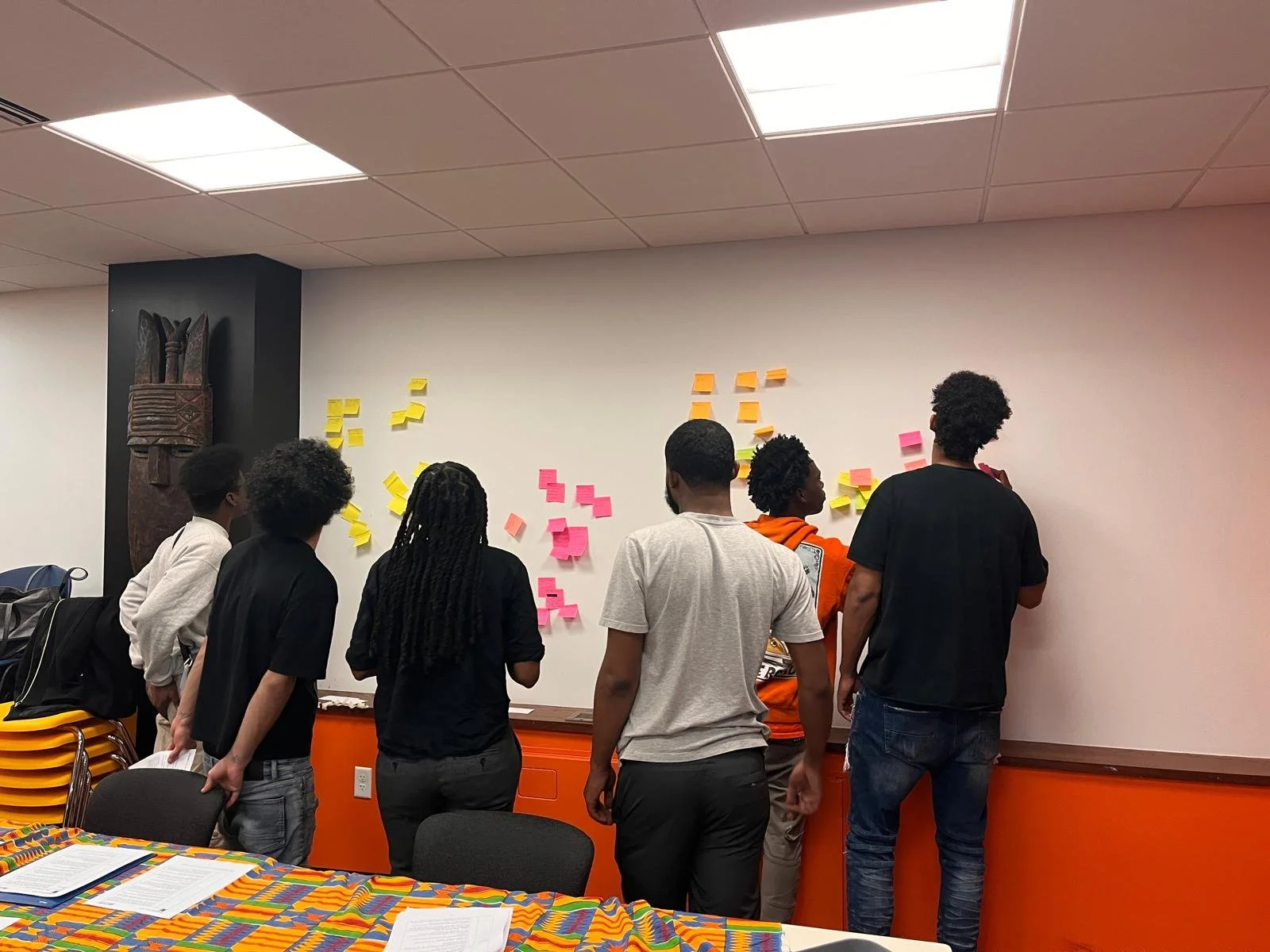
ChampionSTL peer champions participating in a workshop.
Young Black men who have sex with men (YBMSM) face elevated HIV risk in St. Louis, yet testing rates remain persistently low. Through a project called ChampionSTL, Helen Etya’ale, MPH and Dada Dada, MSc sought to develop a feasible strategy for local HIV service organizations to increase testing uptake among YBMSM by engaging them as peer champions and mentoring them in the development and delivery of peer-to-peer science communication.
In collaboration with Community Wellness Project, they co-designed a human-centered design workshop curriculum tailored for YBMSM. Delivered across multiple sessions over two months, the curriculum included activities focused on HIV education, identification of testing barriers, and the development of strategies to increase HIV testing within peer networks. Six YBMSM participated in the workshops; four went on to implement their ideas between January and March 2026, working individually or in pairs. Their strategies included an infographic, a talent show, and a movie night.
In March, the HIV prevention champions presented the outcomes of their work in a showcase event, Talking About HIV: Science, Community, and Communication, alongside community leaders, WashU academic researchers, and faculty. The event provided a space for mutual exchange, learning, and discussion.
Kneeshe Parkinson, Scientific Working Group Coordinator, sat down with Helen and Dada to reflect on the vision, impact, and lessons learned from ChampionSTL, as well as what it means to build hope, equity, and power through community-academic partnerships.
What advice would you give to young people who want to advocate for health in their communities?
Helen and Dada: In 2026, we are being inundated with negative messaging from the powers that be that disparage equity, the health priorities of our communities, and the importance of our lives, all of which strategically serve to make us feel more hopeless and powerless. But you are powerful and capable of more than you might think. Try something that takes you out of your comfort zone in your efforts to advocate. This can be as small as talking to people you know and love about their health needs, getting involved in a grassroots program/campaign/initiative, or leading a larger project. Doing the work is hard but seeing your actions impact others is rewarding and you will be surprised by what you will become in the process.
By working to advocate for your community, despite how easy it is to assume we can’t win and give in before even trying, you are doing the hard work of fostering hope in a better imagined future for yourself and those around you.
Why is it important for researchers and health professionals to communicate science in accessible ways?
Helen and Dada: Social scientists create insights that help us understand how our lives are shaped by the social, political, historical, and economic structures in our societies. Communicating these insights in accessible ways to communities experiencing health inequities helps people understand their lived experience in light of these dynamics, reducing the likelihood to attribute actions to only individual behavior and building critical consciousness. ‘'
Further, scientists have developed a plethora of evidence based practices, within the HIV world and beyond, that can improve health outcomes but do not currently sufficiently reach underserved communities. Communicating about these innovations in accessible ways helps us fulfill our duty as scientists to ensure that our work generates population-level impact.
Finally, what kinds of partnerships are needed to implement community-driven solutions, particularly in St. Louis?
Helen and Dada: Our experience with ChampionSTL underscored the value of community-academic partnerships as a vehicle for centering community voice and leveraging community expertise to address local issues and advance health and well-being in the region. Effective partnerships require community-based organizations that are trusted, experienced, and committed. They also require academics who approach the work with humility, placing their expertise in service of the community’s needs. Most fundamentally, this kind of collaboration must be grounded in a genuine sense of joint ownership, bidirectional learning, and mutual trust.
Interview conducted by Kneeshe Parkinson. Edited by Kate Gershwin.