
Rethinking HIV Care: Lessons from Wendy Armstrong
October 9, 2026
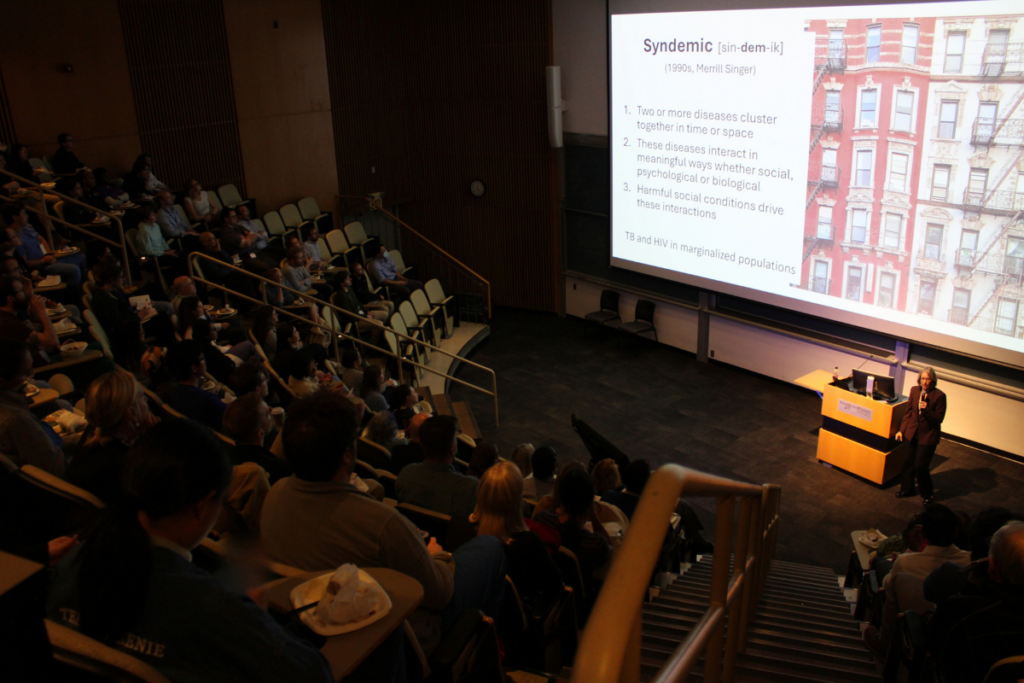
Wendy Armstrong, MD, FIDSA, delivering the J. Russell Little, MD Lecture. Source: Division of Infectious Diseases.
Wendy Armstrong, MD, FIDSA, Professor of Medicine and Division head of the Division of Infectious Diseases at the University of Colorado Anschutz School of Medicine, recently delivered the annual J. Russell Little, MD Lectureship at WashU.
Speaking to a full auditorium, Dr. Armstrong challenged the audience to consider a practical question: how can we make effective HIV care work for people whose needs are poorly served by traditional health services?
Her message was that scientific advances must be paired with changes in care delivery. Housing instability, poverty, stigma, mental health conditions, and substance use can interact to make accessing and remaining in care difficult. Addressing these challenges requires services organized around people’s interconnected needs.
Dr. Armstrong described HIV as a syndemic: a condition that clusters and interacts with other diseases, with harmful social circumstances intensifying their effects. This perspective encourages closer coordination of HIV care, behavioral health, substance use treatment, and other services.
She offered concrete examples of what change can look like. At Seattle’s low-barrier MAX Clinic, patients who entered without viral suppression could access comprehensive care without an appointment, alongside case management and practical support. Dr. Armstrong reported that 80% achieved viral suppression at least once, and 54% achieved continuous suppression. The example illustrated the potential of flexible services for people who have struggled to engage in conventional care.
Learning from global partners was another strong theme. Dr. Armstrong highlighted community health approaches in rural Africa that combined testing for HIV, diabetes, and hypertension with rapid appointments, warm handoffs, flexible hours, and welcoming staff. These approaches strengthened HIV outcomes while also improving care for hypertension. She encouraged the audience to learn from settings that have achieved strong results with fewer resources, including approaches that tailor the intensity and location of care to individual needs.
Long-acting HIV medications offer further opportunities, particularly for people who find daily pills difficult to sustain. However, Dr. Armstrong emphasized that new treatments require staffing, infrastructure, and delivery models that support access. Their promise depends on making them available to people who could benefit most.
Dr. Armstrong closed by encouraging the audience to improve the systems within their reach. She emphasized meeting people where they are, integrating services, learning from resource-limited settings, and continuing efforts to remove barriers to care. Her message extended beyond HIV: advances in treatment must be paired with practical changes in care delivery so that people facing the greatest challenges can benefit.
Watch the lecture and read the Division of Infectious Diseases’ event coverage.
Written by Jacaranda van Rheenen.