
Learning Outside of the Classroom: Trinity’s Internship Journey
October 1, 2026
Written by Trinity Harris, edited by Kate Gershwin
Hello! I’m Trinity Harris, a fourth-year biology student at Harris-Stowe State University (HSSU). When I first started the HSSU-St. Louis Department of Health (STLDOH)-STAR-Midwest D-CFAR internship program, I was excited to learn more about HIV prevention in public health. I knew some information about HIV from school, but I quickly realized there is a lot more to learn about HIV-related work that happens outside of the classroom or lab.
One of the biggest things I learned during this experience was how important it is to make health information easy to understand and accessible. Throughout the internship, I learned about HIV prevention methods like PrEP, testing, and stigma. However, knowing this information is only one part of public health. In order to build successful programs, you also have to think about how people receive that information and whether they feel comfortable using the resources available to them.
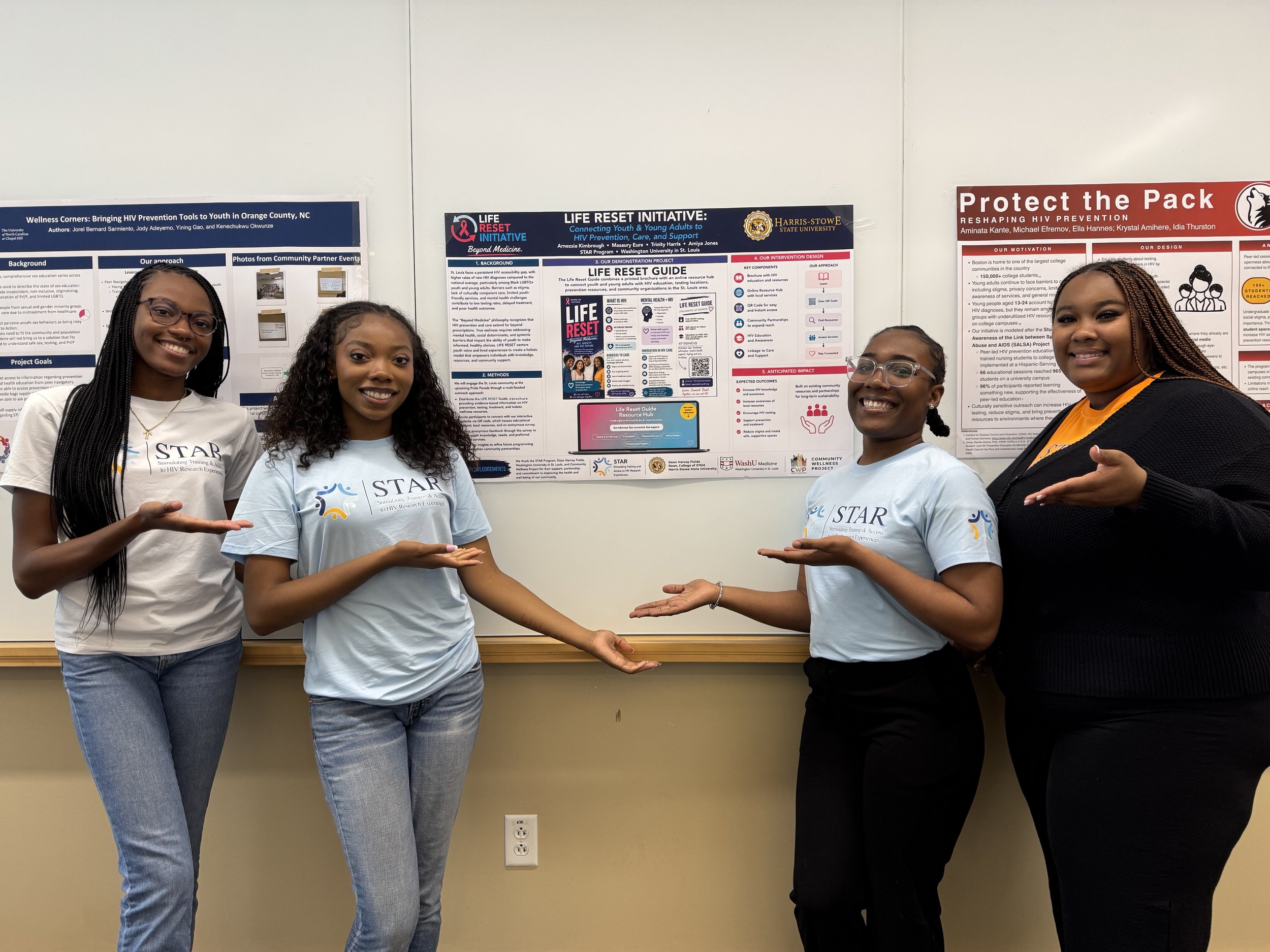
Trinity (center left) and team presenting their STAR internship deliverable, the Life Reset Initiative.
One of my favorite parts of the Internship was working on the Life Reset Initiative, a project we designed as part of the Stimulating Training and Access to HIV Research Experiences (STAR) program. Our group focused on young people ages 13-23 and how we can make HIV and STI prevention more comfortable and accessible for them. We came up with several ideas, including adding testing and PrEP education to spaces where young people already spend time. Working on this project made me think differently about how public health programs are created; you cannot just create a program and expect people to use it. You must understand the people you are trying to reach. We talked about reducing stigma and giving young people more voice and decisions about their health. That was something that really stood out to me because young people should be able to have a say in the programs and resources created for them.
I also enjoyed getting to work with community-based organizations and learning more about what they do. Before this internship, I did not realize how expansive public health work truly is. Researchers, students, healthcare professionals, and community organizations can all play different roles in helping a community.
The internship also helped me step outside of my comfort zone. I got to work with people I had never met before and share my ideas during group discussions and projects. At first, I was nervous about speaking up because I did not always feel like I knew enough. But as the internship continued, I became more comfortable asking questions and sharing my thoughts. Another thing I took away from the experience is how important it is to listen. A big part of public health is understanding what people actually need instead of assuming you already know the answer. Working with other students and hearing different perspectives helped me see how much better an idea can become when everyone has a chance to contribute.
As a biology student, I usually think about science from a more academic perspective, but this internship helped me see how my biology background can connect to public health in ways I had not considered before. I can apply what learned in biology to health education, community outreach, research, and advocacy.
Overall, this internship gave me a much richer understanding of HIV prevention in public health. It also showed me that making an impact on people’s health does not always mean working directly with patients. There are so many other ways to help people through education, research, and building resources that communities can actually use. I am grateful that I had the opportunity to be part of the internship. I learned a lot from the experience and from the people I worked with and most importantly, I feel like I have a better understanding of public health and how I can use what I am learning as a biology student to make an impact in the future.